Panormitis Monastery and Symi's Beaches: The Archangel's Bay, St George's Cove and the Taxi-Boats
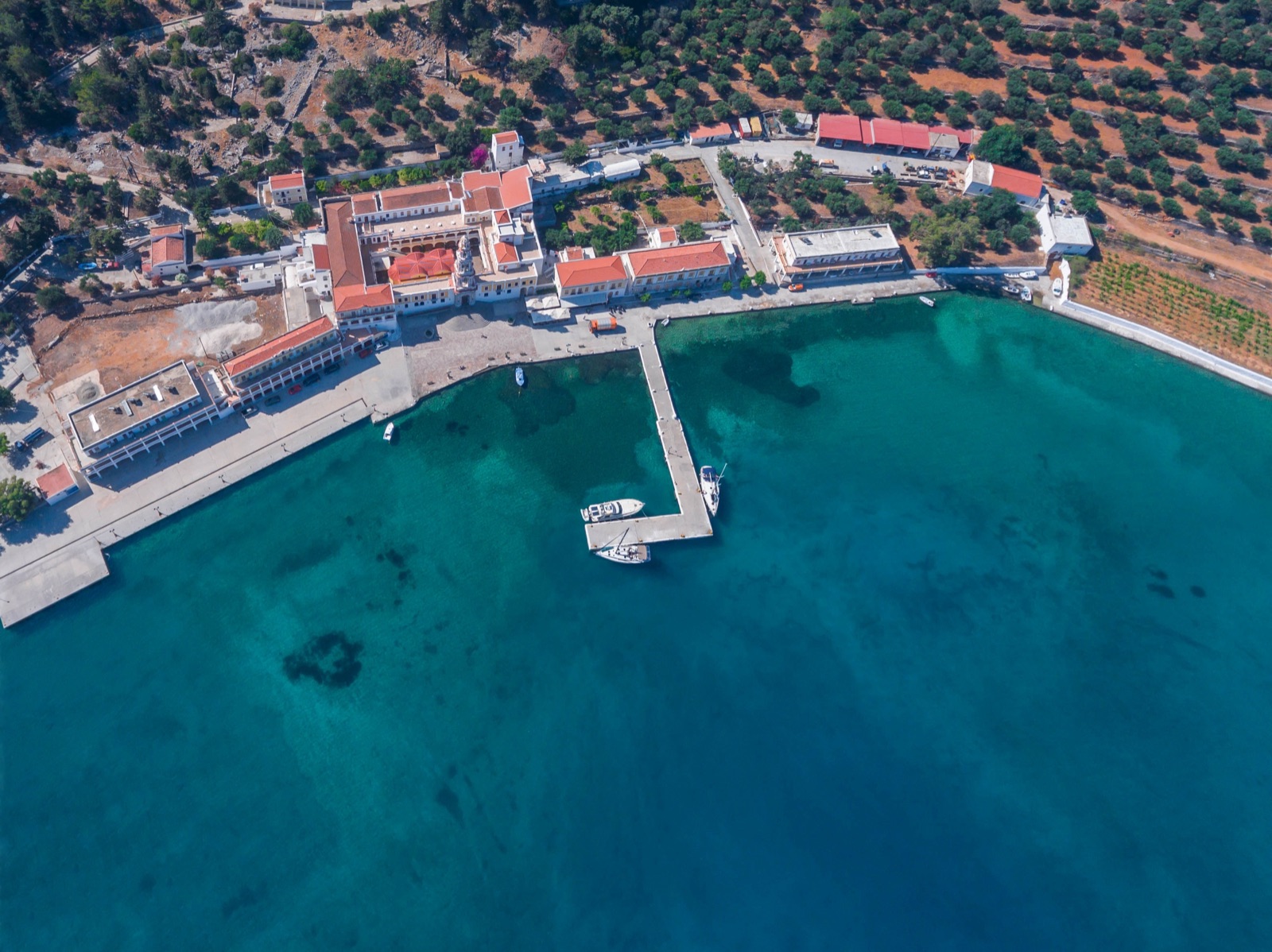
Beyond Symi town, the island is wild: bare hills, pine-covered slopes and a coastline of cliffs and coves, much of it reachable only by sea. In a sheltered bay in the south-west stands the monastery of the Archangel Michael at Panormitis, the island’s great pilgrimage site, whose bell tower greets every boat that enters the bay. Around the coast, taxi-boats carry swimmers to beaches with no roads, some beneath towering cliffs.
This guide covers the monastery of Panormitis — its history, its icon, its museums and its traditions — and the beaches of Symi, from the easy town beaches to the coves you can reach only by boat.
Panormitis at a glance
- The monastery of Archangel Michael of Panormitis, in a sheltered bay in the south-west of Symi, is the island’s most important pilgrimage site; it was built in the early 18th century on the foundations of earlier churches.
- It is the most important monastery on Symi and the second largest in the Dodecanese, after St John’s on Patmos.
- The Archangel Michael Panormitis is the island’s patron saint and the guardian of sailors across the Dodecanese.
- Panormitis lies on a sheltered cove with a small sandy beach, behind a narrow inlet.
The monastery
Arriving by sea
Most visitors arrive by boat, and the approach is unforgettable: the narrow entrance to the bay opens out, and the long white façade of the monastery stretches along the shore. A multi-storey Baroque bell tower welcomes pilgrims arriving by boat.
The Katholikon and the icon
At the heart of the monastery is its church. Its Katholikon dates from the 15th century and holds the full-length icon of the Archangel Michael, covered in silver and gold, with Byzantine frescoes and a carved wooden iconostasis. The icon is the focus of the pilgrimage, and the church around it glitters with the gifts of the faithful. Even visitors who are not religious tend to fall quiet here: the combination of candlelight, silver and the steady stream of pilgrims gives the church an atmosphere quite different from the busy quay outside.
Inside the church
The church holds the two-metre-high, silver-leafed icon of the Panormitis, and its interior is covered in iconography, including a ‘fall of the angels’ mural. Chandeliers hang from the ceiling, and the walls are hung with the gifts of pilgrims. Stand back for a moment to take in the whole interior before approaching the icon.
The legend of the icon
Like many famous icons, this one has its story. One story says the icon appeared miraculously and, several times removed, mysteriously returned to the same spot, where the church was then built.
Promises to the Archangel
The Archangel is known in the Dodecanese for holding people to their word. According to legend, anyone who asks the Archangel for a favour must promise something in return. Dodecanese islanders traditionally offered brooms, and monks said they heard the saint sweeping the monastery at night. And a well-known story tells of boats unable to leave the quay until a passenger fulfils a forgotten promise to the Archangel.
The museums and library
The monastery has an Ecclesiastical Museum and a Folklore Museum, and its library keeps rare Byzantine manuscripts. The Ecclesiastical Museum holds votive offerings brought by pilgrims and sailors over the centuries; the Folklore Museum shows everyday life on Symi in the past.
The bottle offerings
One tradition is unique to Panormitis. Tradition holds that votive offerings sent by the faithful, often in bottles, drift across the sea and wash up in the monastery’s bay. Messages and gifts cast into the sea far away are said to find their way here. Some of these messages are kept in the museum, where visitors can read them, a touching record of hopes and prayers carried by the sea.
The 1944 memorial
The monastery also remembers a dark chapter. A memorial commemorates a former abbot, two monks and two teachers executed in 1944 for running a spy radio for British commandos.
Visiting Panormitis
By boat from Rhodes
Several boats from Rhodes stop at Panormitis:
Symi and Panormitis Monastery by ferry. A day boat from Rhodes with two stops: the Monastery of Archangel Michael at Panormitis and Symi town. Deck or indoor seats. About 9 hours.
Speedboat to Symi town and Panormitis. A speedboat from Rhodes to Symi town and the Monastery of Panormitis, with free time in town. About 7.5 hours.
From 1 April 2026, Dodekanisos Seaways runs daily between Rhodes, Symi and Panormitis, with a morning departure from Rhodes at 08:30.
From Symi town
If you are staying on Symi, a road links the monastery with Symi town: over six hours on foot, or about an hour by local bus or scooter.
Avoiding the crowds
The monastery fills with day-trippers from Rhodes; for peace, wait until they have gone. If you are staying on Symi, visit early in the morning or late in the afternoon, when the courtyard is quiet.
Panormitis Day
The tourist season runs from Easter to Panormitis Day in early November, when pilgrims gather at the monastery for the feast of the Archangel. It is the busiest and most moving day of the monastery’s year.
Respecting the monastery
- Dress respectfully; this is a working monastery and a place of pilgrimage.
- Keep your voice down in the church and courtyard.
- Ask before photographing inside the church.
- Remember the tradition: many pilgrims come to fulfil promises to the Archangel.
Staying at Panormitis
Panormitis is not only a day-trip stop. Two rows of buildings along the shore, built after the Second World War, now hold holiday flats for visitors and a bakery; the monastery’s guest house can host up to 500 people. Staying overnight lets you see the monastery in the quiet of the evening and early morning, when the day boats have gone and the bay is still.
Symi’s other monasteries
Panormitis is the most famous, but not the oldest. The monastery of Archangel Michael Roukouniotis, built by the Knights of St John in the 15th century, is by tradition the oldest on the island.
A monastery of sailors
Panormitis makes most sense against Symi’s seafaring past. The economy was traditionally based on shipbuilding and sponges; today its main industry is tourism, and for centuries the island’s men spent their lives at sea. A saint who protected sailors mattered deeply to such a community, and the gifts that fill the church and the Ecclesiastical Museum — many of them connected with the sea — are the record of that devotion. The Knights of St John conquered Symi in 1309, beginning centuries of prosperity from trade, and Symi grew rich on sponges and at one point had the largest sponge-fishing fleet in the world.
A visit to Panormitis, step by step
- Arrival: the boat enters the bay beneath the bell tower and ties up in front of the monastery.
- The courtyard: step through the main gate into the inner courtyard.
- The church: the Katholikon, its frescoes, the iconostasis and the silver icon of the Archangel.
- The museums: the Ecclesiastical Museum and the Folklore Museum, if time allows.
- The bay: a moment on the shore, where the bottle offerings are said to wash up, and perhaps a swim from the small sandy beach.
- Departure: back on board for Symi town or Rhodes.
On a day trip, the stop may be short, so decide in advance whether the church, the museums or a swim matter most to you.
Symi’s beaches
Getting to the beaches
Symi’s coastline is steep and rocky, and many of its best beaches have no road. Some are a walk from town; others are reached only by taxi-boat or excursion boat from Gialos.
Agios Georgios Dysalona (St George’s Bay)
The most dramatic beach on the island. Agios Georgios Dysalona is a small pebble beach on the east coast beneath a sheer cliff about 300 m high; no road reaches it, so every visitor arrives by taxi-boat or excursion boat from Gialos, and the cliff puts it in shade by early afternoon. It has no bar, taverna or sunbeds, so bring water, food and shade.
Two of the Rhodes day trips stop here for a swim:
High-speed boat to Symi and St George’s Bay. A modern fast boat from Rhodes, three hours of free time in Symi’s harbour town and a swim in St George’s Bay, reached only by boat. About 6–9 hours.
Cruise to Symi with a hotel transfer. The same trip with optional hotel transfers from Faliraki, Ixia, Kremasti and Kolymbia, and guaranteed open-air seating. About 6 hours.
Nanou and Marathounta
Further along the coast are sandy bays: day boats from Gialos combine Agios Georgios Dysalona with the sandy bays of Nanou and Marathounta, making a full day of swimming stops. Marathounta is also one of the island’s small settlements.
Pedi and Nos
For an easy swim near town: Pedi and Nos, the town beach, are sandy and lined with tavernas. They are the simplest option if you are staying in Gialos and want a swim without a boat trip.
Panormitis
Panormitis lies on a sheltered cove with a small sandy beach, behind a narrow inlet, so a stop at the monastery can include a swim.
The coast by boat
Seen from a taxi-boat, Symi’s coastline is a series of headlands and inlets, bare rock dropping into deep blue water, with the occasional chapel or cluster of houses on the shore. The boats from Gialos work their way along it, dropping swimmers at the coves and collecting them later. Even if you only want one beach, the ride itself is worth it, and the views back towards the town and out towards the Turkish coast — Symi lies about 24 km north of Rhodes, and its nearest neighbours are the Datça and Bozburun peninsulas of Turkey — are part of the experience.
Planning a beach day
- Morning: a taxi-boat from Gialos to Agios Georgios Dysalona, to swim before the cliff puts the beach in shade.
- Midday: on to Nanou or Marathounta for lunch and a longer swim.
- Afternoon: back to Gialos, or a final swim at Nos or Pedi.
- Evening: the harbour at dusk.
Tips for taxi-boats
- Confirm the return time before you step ashore; there is no other way back from the boat-only coves.
- Bring everything you need: water, food, shade and snorkel gear.
- Check the sea: calm mornings give the smoothest ride.
- Carry cash for the boats and beach tavernas.
What to pack for a beach day
- Water and food, especially for the coves with no taverna.
- Shade: a parasol or sunshade, although at Agios Georgios Dysalona the cliff shades the beach by early afternoon.
- Snorkel and mask for the clear water.
- Water shoes for the pebbles.
- Cash for the taxi-boats.
- A bag for your rubbish, to leave the coves as you found them.
Photography
- The monastery from the sea, with the bell tower rising above the bay.
- The cliff at Agios Georgios Dysalona, towering over the pebble beach.
- The icon and the church interior, if photography is permitted.
- The coastline from the taxi-boats, with its coves and headlands.
Swimming safely
- Watch the depth: some coves shelve quickly into deep water.
- Stay near the shore if you are not a strong swimmer.
- Use sun protection; there is often little shade.
- Keep an eye on boats coming in and out of the coves.
Walking on Symi
The island’s interior has old paths between monasteries, chapels and bays. Walking here is rewarding but demanding: the terrain is rocky and the summer heat intense. A road links the monastery with Symi town: over six hours on foot, or about an hour by local bus or scooter, a measure of how far things are. Walk in the cooler months or early in the day, carry plenty of water, tell someone your route and stay on marked paths.
Combining Panormitis with Symi town
Most visitors see Panormitis and Symi town on the same day. On the day trips from Rhodes, the boat usually stops at one and then the other, so you get the monastery’s calm and the town’s bustle in a single outing. If you are staying on the island, give each its own time: a morning at Panormitis by bus or scooter, and an evening in Gialos when the harbour is at its loveliest. Our guides to Symi town and getting to Symi cover the rest of the island and the boats from Rhodes.
When to go
- Spring and autumn are ideal for walking and for visiting Panormitis in peace.
- Summer is the season for swimming and taxi-boats, but also the busiest time at the monastery.
- Early November brings Panormitis Day, the island’s great pilgrimage.
- Winter is quiet, with boats still running every day.
With children
Children usually enjoy the boat trips and the swimming stops. Pedi and Nos are the easiest beaches for families; the pebble cove at Agios Georgios Dysalona is dramatic but has no facilities, so pack well. At Panormitis, the museums and the bottle-offering tradition often capture children’s imaginations.
Accessibility
Panormitis is reached by boat or by road from Symi town; ask about access to the church and museums when you arrive. Most of Symi’s beaches involve boats, pebbles or steps, and the boat-only coves are difficult for visitors with limited mobility. Ask boat operators about assistance.
Frequently asked questions
How do I get to Panormitis Monastery?
By boat from Rhodes — several day trips stop there, and Dodekanisos Seaways runs daily between Rhodes, Symi and Panormitis — or by road from Symi town, about an hour by local bus or scooter.
What is special about Panormitis?
It is Symi’s most important pilgrimage site and the second largest monastery in the Dodecanese. Its 15th-century Katholikon holds a full-length icon of the Archangel Michael covered in silver and gold, and tradition holds that offerings in bottles wash up in its bay.
How do I get to St George’s Bay on Symi?
Only by boat: taxi-boats and excursion boats run from Gialos, and some Rhodes day trips stop there for a swim.
Are there sandy beaches on Symi?
Yes. Pedi and Nos, the town beach, are sandy, and so are the bays of Nanou and Marathounta, reached by boat.
When is Panormitis Day?
In early November, at the end of the tourist season.