Symi Town Guide: Gialos Harbour, the Kali Strata and Horio
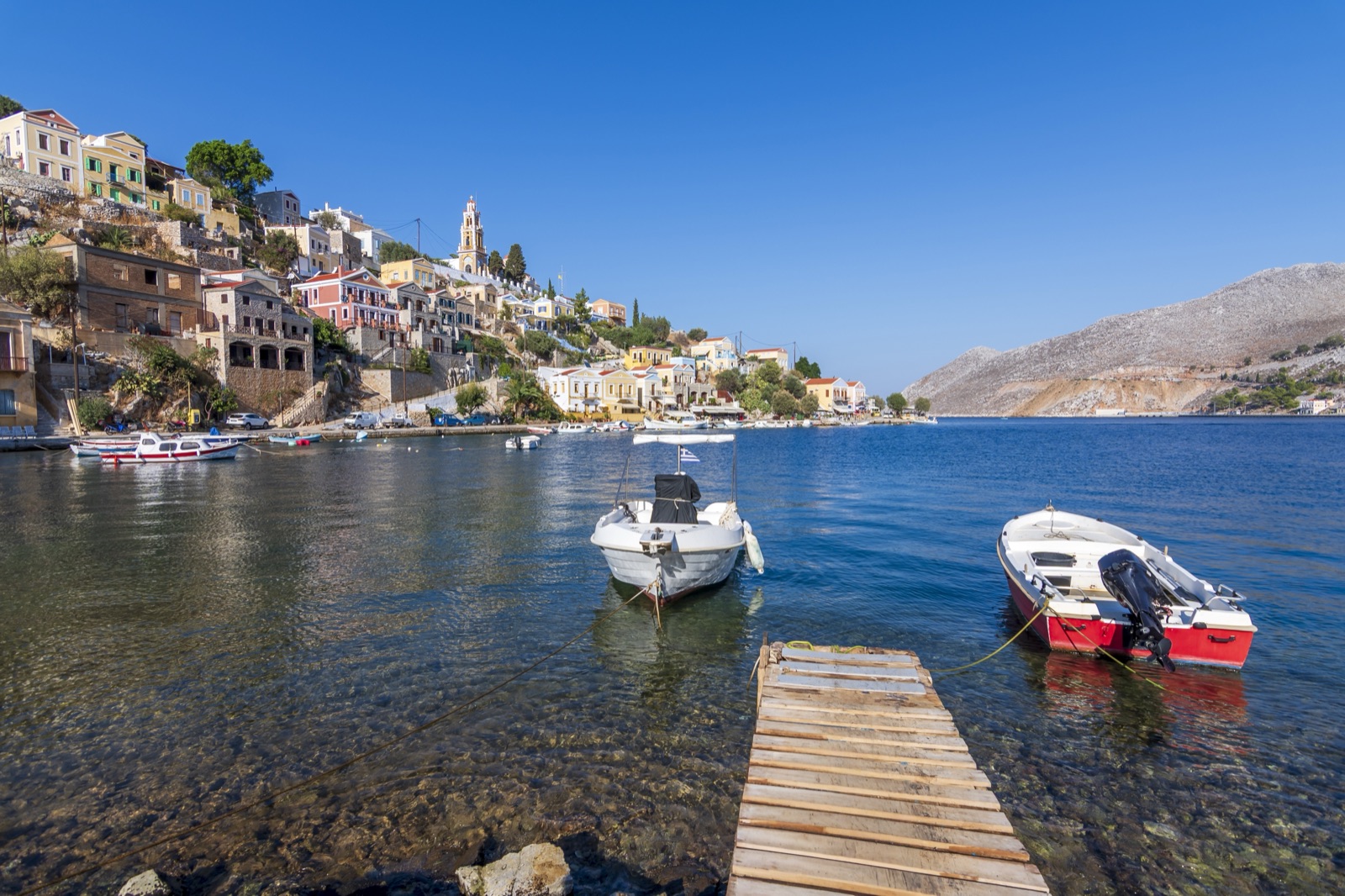
Symi town is two towns in one. Down by the water, Gialos wraps around a deep harbour, its quayside lined with cafés, boats and the grand façades of the merchants’ mansions. Up on the ridge, Horio — Ano Symi — is a maze of lanes, churches and courtyards, crowned by the ruins of a castle. Between them runs the Kali Strata, a broad stairway of stone that has carried islanders up and down for generations.
This guide covers what to see in both parts of town, the story behind the mansions, the climb up the Kali Strata, the museums and the castle, and how to fit it all into a day trip or a longer stay.
Symi town at a glance
- The main town is Symi, with Yialos (Gialos) around the harbour and Horio (Ano Symi) above; other settlements include Pedi, Nimborio, Marathounda and Panormitis.
- Ano Symi (Horio) is reached from the harbour by a stone stairway of about 500 steps, the Kali Strata, ‘Good Way’.
- Symi was at its most prosperous in the mid-19th century, when many of the colourful neoclassical mansions on the slopes were built.
Gialos: the harbour town
The harbour
Gialos is where every visitor arrives, and it is the Symi of the photographs: a deep, narrow harbour ringed by pastel mansions stacked up the hillsides. The harbour of Gialos is a popular marina for sailors, so yachts share the quay with ferries and fishing boats.
The clock tower
At the harbour entrance stands the town’s landmark. The clock tower has stood at the entrance to the harbour since 1881, a gift of the Petridis family, and is the first sight for arriving ferries. It is visible from much of the town and makes a useful reference point as you explore.
The cathedral
Near the waterfront is the island’s cathedral. The cathedral of Timios Prodromos, near the Gialos waterfront, was built in 1830 and renovated in 1869.
The mansions
The houses that give Gialos its beauty were built on the island’s trading wealth. Symi grew rich on sponges and at one point had the largest sponge-fishing fleet in the world, and the economy was traditionally based on shipbuilding and sponges; today its main industry is tourism. Tourism has led to the restoration of many homes, a great number of which were destroyed during the Second World War — and the work is done carefully: restorations of the island’s houses must follow guidelines set by the Greek Archaeological Service, which is why the town keeps its harmonious look.
Why two towns?
The shape of Symi town follows its history. Ships anchored in the deep harbour at Gialos, so trade gathered at sea level, while homes and churches spread up the safer ground of Chorio on the ridge. The two halves grew together into one town, but they still feel different: Gialos busy and open to the sea, Horio quiet and inward-looking, its lanes built for walking rather than wheels.
The Kali Strata
The stairway
The Kali Strata is the main link between the harbour and the upper town. Ano Symi (Horio) is reached from the harbour by a stone stairway of about 500 steps, the Kali Strata, ‘Good Way’. It is not a rough path but a broad, stepped street, climbing past some of the grandest houses on the island.
A street, not a path
The Kali Strata was the main artery of the town before the coastal road reached the harbour. Families climbed it every day to reach their homes, shops and churches, and it still works as a street, used by residents as much as by visitors.
The houses along the way
The climb is a walk through Symi’s history. Merchants and sponge captains built their houses along the Kali Strata. Some are restored and lived in; others stand as empty shells, their façades still elegant.
When to climb
About 500 steps are hard work in the heat. The steps are lit after dark, and the cool hours of early morning and evening suit the climb. On a day trip, go up early in your visit and come down slowly; if you are staying, climb at dusk and watch the lights come on around the harbour below.
Horio: the upper town
The old town
At the top of the Kali Strata, Horio spreads across the ridge in a tangle of lanes, courtyards and chapels. Ano Symi has churches dating from Byzantine times, an archaeological museum and the Kastro, the Castle of the Knights of St John. It is quieter than Gialos, and the views over the harbour are the best on the island.
The Archaeological Museum
The Archaeological Museum of Symi, in the Agios Athanasios quarter of Chorio, spreads over three levels, including two 18th- and 19th-century mansions, with objects from prehistory to the 19th century. It is as much a chance to see inside two historic houses as a collection of objects. The rooms, courtyards and gardens give a sense of how Symi’s wealthier families lived when the island was at its height, and the displays follow the island from its earliest inhabitants to the 19th century, when the mansions of Gialos were being built. Allow an hour, and combine the visit with the castle, a short walk further up.
The Historical Museum
The renovated Historical Museum of Symi reopened in late 2020, telling the island’s story through its collections. Together with the Archaeological Museum, it gives a fuller picture of how a small, rocky island grew so prosperous, and what happened to it in the century that followed.
The castle
At the top of Horio are the remains of the castle. The Knights’ castle was built in the 14th century on the ruins of a Byzantine castle; the chapel of the Virgin of the Castle at its highest point looks over Horio and Yialos. The view from here takes in the whole town and the harbour below. It is the best place to understand how Gialos and Horio fit together, and to see just how many steps you have climbed.
Symi’s history in brief
- Myth: in myth, Symi is the birthplace of the Charites, the Graces, and takes its name from the nymph Syme.
- Homer: in Homer’s Iliad, Symi is the domain of King Nireus, called the most handsome of the Greeks after Achilles.
- The Knights: the Knights of St John conquered Symi in 1309, beginning centuries of prosperity from trade.
- The Ottomans: in 1522 Symi was conquered by the Ottomans, but it kept many of its privileges and its prosperity continued.
- The golden age: in the 19th century the island boomed on sponges and shipbuilding, and Symi had 2,603 permanent residents in 2021; its population peaked at about 22,500 in the 19th century.
- Italian and German rule: in 1912 the Dodecanese declared independence from the Ottomans but were almost immediately occupied by Italy; Symi was formally ceded to Italy in 1923 and occupied by the Germans on 12 October 1943.
- The surrender: on 8 May 1945, on Symi, General Otto Wagener signed the surrender of all German forces in the Dodecanese to Brigadier F. Moffat of the British Army.
- Union with Greece: Symi became part of Greece in 1948, after three years of British occupation.
Monasteries near town
Symi has many churches and monasteries beyond the famous one at Panormitis. The monastery of Archangel Michael Roukouniotis, built by the Knights of St John in the 15th century, is by tradition the oldest on the island. For Panormitis itself, see our guide to Panormitis and Symi’s beaches.
Beaches near town
- Nos and Pedi: Pedi and Nos, the town beach, are sandy and lined with tavernas.
- By taxi-boat: the coves further along the coast, including Agios Georgios Dysalona, Nanou and Marathounta, are reached by boat from Gialos.
Symi by night
When the day boats leave, Symi town changes. The harbour empties of day visitors, the lights of the mansions reflect in the water, and the cafés and tavernas along the quay fill with residents and those staying on the island. The Kali Strata, lit after dark, is at its most atmospheric, and the climb to Horio in the evening cool is a pleasure rather than a chore.
Photography
- From the Kali Strata, looking back over the harbour as you climb.
- From the castle at the top of Horio, with the whole town below.
- The clock tower at the harbour entrance, especially in the evening light.
- The mansions of Gialos from the water, if you arrive by boat.
- The lanes of Horio, with their doorways, courtyards and pebbled yards.
Eating and shopping
The quayside of Gialos is lined with cafés and tavernas, and the lanes behind it hold small shops. Look out for sponges, the source of the island’s old wealth. For a quieter meal, look for places in Horio or a street or two back from the harbour, and linger over lunch rather than rushing back to the boat.
Walking beyond town
Symi rewards walkers, but the island is hot, rocky and hilly. A road links the monastery with Symi town: over six hours on foot, or about an hour by local bus or scooter, which gives an idea of the distances involved. Carry plenty of water, start early, tell someone your route, and keep to marked paths.
Planning your time
Three hours on a day trip
- Hour one: straight up the Kali Strata while you are fresh, with stops for photographs of the harbour.
- Hour two: Horio, its lanes, and the castle viewpoint; the Archaeological Museum if time allows.
- Hour three: back down to Gialos for lunch by the water and a look at the clock tower and cathedral.
A day or more
- Morning: the Kali Strata and Horio, the Archaeological Museum and the castle.
- Afternoon: a swim at Nos or Pedi, or a taxi-boat to a quieter cove.
- Evening: the harbour at dusk, when the day boats have gone and the lights come on.
Getting there
The shortest Rhodes–Symi crossing takes 45 minutes and boats run every day, all year. Most crossings take about 1 to 1.5 hours, and tickets start from around €7. Day trips from Rhodes include:
Speedboat to Symi with free time. A speedboat from Rhodes’ Kolona harbour past the old town, with free time in Symi to eat, shop and wander. About 7 hours.
Cruise to Symi with a hotel transfer. With optional hotel transfers from Faliraki, Ixia, Kremasti and Kolymbia, guaranteed open-air seating and a stop at St George’s Bay. About 6 hours.
High-speed boat to Symi and St George’s Bay. Three hours of free time in Symi’s harbour town and a swim in St George’s Bay, reached only by boat. About 6–9 hours.
The tours page lists them all with live prices, and our guide to getting to Symi covers the ferries.
A walk around Gialos
Before or after the climb, a slow circuit of the harbour shows Gialos at its best. Start at the clock tower at the harbour entrance, follow the quay past the moored yachts and fishing boats, and stop at the cathedral of Timios Prodromos near the waterfront. Look up as you go: the mansions rise in tiers above the quay, some freshly painted, some still waiting for restoration, their pediments and tall windows a record of the island’s golden age. The walk takes as long as you want it to, with cafés to stop at all the way round.
When to visit
- Spring and autumn are the best times to explore the town on foot, with warm days and cooler evenings for the climb to Horio.
- Summer is hot, and the midday sun on the steps is fierce; plan the climb for early morning or evening.
- Early November brings Panormitis Day, when the tourist season ends and pilgrims gather at the monastery.
- Winter is quiet, with the town belonging to its residents and boats still running every day.
Where to stay
Staying in Gialos puts you by the harbour, the boats and the cafés; staying in Horio means quieter nights, wider views and a daily climb on the Kali Strata. Either way, spending at least one night on the island means you see the town before the day boats arrive and after they leave — the times when it is at its most beautiful.
Practical tips
- Climb the Kali Strata early or late, avoiding the midday heat.
- Wear shoes with grip; the stone and marble steps can be slippery.
- Carry water, especially for the climb.
- Check the museum hours before you go: museum hours can change in hot weather: on 24 July 2025 the Archaeological Museum closed from 12:00 to 15:30 because of high temperatures.
- Respect the churches: dress respectfully and keep noise down.
- Leave time for the harbour at the end of the day.
With children
Children enjoy the boats in the harbour and the view from the castle, but the Kali Strata is a long climb for small legs, especially in summer. Go early, take breaks on the landings, and reward the effort with a swim afterwards at Nos or Pedi.
Accessibility
The harbour front at Gialos is level and has most of the cafés and shops. Horio is reached by the Kali Strata’s roughly 500 steps, and its lanes are steep and stepped, so much of the upper town is difficult for visitors with limited mobility. The Archaeological Museum lists facilities for visitors with disabilities; check before visiting.
Frequently asked questions
How many steps are there on the Kali Strata?
About 500. The stairway links the harbour of Gialos with Horio, the upper town.
When was Symi’s clock tower built?
It has stood at the entrance to the harbour since 1881, a gift of the Petridis family.
Why are Symi’s houses so grand?
Symi grew rich on sponges and shipbuilding, and was at its most prosperous in the mid-19th century, when many of the neoclassical mansions were built.
What happened on Symi in 1945?
On 8 May 1945, General Otto Wagener signed the surrender of all German forces in the Dodecanese on Symi.
Is there a castle on Symi?
Yes. The Knights’ castle at the top of Horio was built in the 14th century on the ruins of a Byzantine castle.